
Search Results:
Search Results:
Search Results:
Search Results:

Every GT High Performance smoke alarm contains an infrared sensor. Any existing infrared remote in the house will hush it: a television remote, an air conditioner remote, a sound bar remote. No ladder, no broom handle, no standing on a kitchen chair waving a tea towel at the ceiling.
The hush is temporary. The alarm returns to normal operation on its own, so it cannot be left disabled by accident.
This works with infrared remotes only. Bluetooth and RF remotes will not silence a GT smoke alarm. That includes the Foxtel iQ remote, Apple TV, and many newer smart television remotes.
If the remote had to be paired to the device before it worked, it is not infrared. If it only works when pointed at the device, it is infrared and it will hush a GT smoke alarm.
A traditional photoelectric smoke alarm uses a single red LED and a photocell. It detects particles in the sensing chamber, but it gathers little information about what those particles are. That is why steam from a shower and dust from a renovation set off so many alarms.
GT smoke alarms use a split spectrum chamber. The traditional photoelectric sensor is paired with a second blue LED. The two wavelengths respond differently to different particle sizes, so the alarm has more information to work with when deciding whether it is seeing combustion smoke or steam, dust and vapour.
GT designs the alarm to be conservative about dismissing an alarm condition. Reducing nuisance alarms matters, but detecting a real fire matters more, and the alarm is built to err in that direction.
Photoelectric alarms respond faster to smouldering fires, which are the fires that kill people in their sleep. Australian fire services recommend photoelectric alarms, and several states now mandate them. Every alarm in the GT range is photoelectric.
Every smoke alarm in Australia has a maximum service life of 10 years and must be replaced at the end of it. That applies even if the alarm still chirps when the test button is pressed. The replacement date is driven by the manufacture date printed on the alarm, not by how the alarm sounds.
There are three good reasons for the rule:
GT warrants its alarms for 10 years, which is the full mandated service life of the unit. The alarm is covered for as long as it is legally allowed to remain in the ceiling.
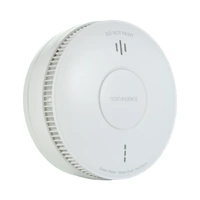
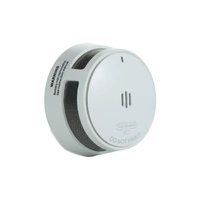
GT10 is a standalone alarm with a sealed 10-year lithium battery. There is nothing to change, no 3am low-battery chirp, and the battery lasts the working life of the alarm.
GT10RF is the same alarm with wireless interconnect built in, so alarms trigger together across the house without running cable.
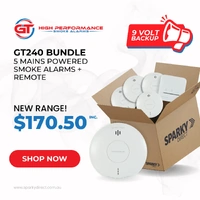
GT240 is mains powered with a user-replaceable 9V backup battery, and interconnects by wiring.
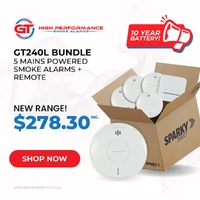
GT240L is mains powered with a sealed rechargeable lithium backup, so there is no battery to replace for the life of the alarm.
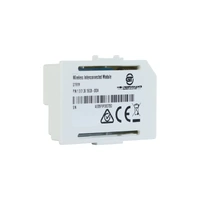
GTRFM is the wireless interconnect module for GT smoke alarms. It suits jobs where running interconnect cable is not practical: retrofits, renovations and existing homes.
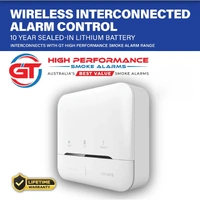
GTREMOTE is a wall-mounted controller for a wireless interconnected system. It carries two buttons and three indicators.
LOCATE is the function installers tend to appreciate most. Interconnected alarms solve one problem and create another, and LOCATE solves the second one.
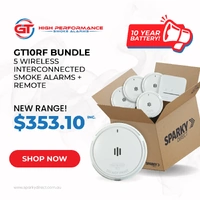
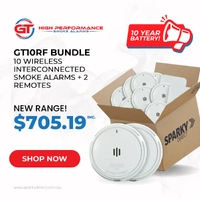
GT240, GT240L and GT10RF are also supplied as 5-alarm bundles with a controller included. Five alarms is the usual quantity for a standard home, so the bundle covers a full house in a single line item.
The choice comes down to two questions: is there mains power at the alarm position, and does the job need interconnect without running cable.
| Model | Power | Battery | Interconnection | Best for |
|---|---|---|---|---|
| GT10 | Sealed lithium | 10-year sealed lithium, non-replaceable | Standalone | Simple replacements |
| GT10RF | Sealed lithium | 10-year sealed lithium, non-replaceable | Wireless, built in | Cable-free retrofits |
| GT240 | 240V mains | Replaceable 9V backup | Wired, or wireless with GTRFM | New builds and rewires |
| GT240L | 240V mains | Sealed rechargeable lithium backup | Wired, or wireless with GTRFM | Low-maintenance mains installations |
On GT10 and GT10RF the sealed lithium cell is the alarm's only power source, not a backup, and it lasts the full 10-year service life. On GT240 and GT240L the battery is a backup that holds the alarm up during a mains failure.
Heat alarms are a separate device and are not a substitute for a smoke alarm. They suit garages, kitchens and other spaces where cooking fumes or exhaust would trigger a smoke alarm constantly. The heat alarms range covers those positions.
Interconnection means that when one alarm detects smoke, every alarm in the dwelling sounds. Most states now require interconnected alarms in new builds, in rentals and in homes being sold. There are two ways to achieve it with the GT range.
GT240 and GT240L interconnect by cable. Wired interconnect suits new builds and rewires, where the interconnect conductor can be run at the same time as the lighting circuit. It is the most robust method because there is no radio path to maintain.
GT10RF has wireless interconnect built in. GT240 and GT240L can be linked wirelessly by fitting a GTRFM module. Wireless interconnect suits retrofit work in occupied homes, where pulling cable through an existing ceiling means lifting tiles or cutting plaster.
Check before quoting: smoke alarm legislation differs between states and territories. Requirements for rental properties and for homes being sold are stricter than for owner-occupied dwellings. Confirm the current requirements for the relevant state before starting work.
All GT smoke alarms sold by Sparky Direct are certified to AS 3786:2014 including Amendments 1 and 2.
Mains-powered alarms must be installed by a licensed electrician and wired in accordance with AS/NZS 3000. Installation of the alarm is only part of the job: alarm placement, the number of alarms and the interconnect requirement are all set by state legislation and by the National Construction Code.
An installation tester is worth carrying for interconnect verification on multi-alarm jobs. The electrical test equipment range covers the instruments used for that work.
Trusted brands • Expert advice • Fast Australia-wide delivery
Shop GT Smoke Alarms → Get Expert Advice →No. The test button confirms that the power supply and the sounder work. It does not confirm that the sensing chamber still responds to smoke at the correct sensitivity. This is one of the reasons smoke alarms are replaced at 10 years: the sensor ages as the chamber samples air continuously for a decade, and dust and insects accumulate inside it.
Yes. Mains-powered alarms must be installed by a licensed electrician and wired in accordance with AS/NZS 3000. Installation is only part of the job: alarm placement, the number of alarms and the interconnect requirement are all set by state legislation and by the National Construction Code.
Yes. All GT smoke alarms sold by Sparky Direct are certified to AS 3786:2014 including Amendments 1 and 2. GT10 and GT10RF are covered by Certificate of Suitability EESS-240646-0, issued by Conformity Certification Services. GT240 and GT240L are covered by BSI Benchmark Certificate BMP 807093.
GTREMOTE is a wall-mounted controller for a wireless interconnected GT system. TEST/SILENCE tests and hushes the interconnected alarms from one accessible spot instead of visiting each unit. LOCATE identifies which alarm in the system initiated, so when every alarm in the house is sounding at 2am it points to the right room. FIRE, CO and FAULT indicators show system status at a glance.
Yes. GT240 and GT240L interconnect by cable as standard, and a GTRFM wireless interconnect module links them wirelessly instead. This suits retrofit work in occupied homes, where pulling cable through an existing ceiling means lifting tiles or cutting plaster.
Yes. GT10RF has wireless interconnect built in. GT240 and GT240L can be linked wirelessly by fitting a GTRFM wireless interconnect module. Wired interconnect remains the most robust method because there is no radio path to maintain, so it suits new builds and rewires where the interconnect conductor can be run alongside the lighting circuit.
Both are 240V mains powered and both interconnect by wiring. GT240 has a user-replaceable 9V backup battery. GT240L has a sealed rechargeable lithium backup, so there is no battery to replace for the life of the alarm.
Both run on a sealed 10-year lithium battery. GT10 is a standalone alarm. GT10RF is the same alarm with wireless interconnect built in, so alarms trigger together across the house without running cable.
It depends on the model. GT10, GT10RF and GT240L have sealed batteries that last the full 10-year life of the alarm, so there is nothing to change and no low-battery chirp at 3am. GT240 is mains powered with a user-replaceable 9V backup battery.
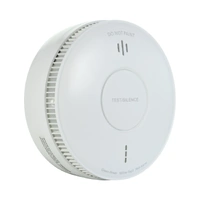
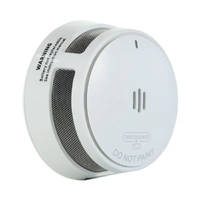
GT High Performance smoke alarms are photoelectric smoke alarms certified to AS 3786:2014, the Australian Standard for domestic smoke alarms. The range covers 10-year sealed lithium alarms, 240V mains alarms, a wireless interconnect module and a wall-mounted alarm controller. Two features separate GT from most other photoelectric alarms: every GT smoke alarm can be silenced with an infrared remote, and every GT smoke alarm uses split spectrum sensing.
GT warrants its smoke alarms for 10 years, which is the full mandated service life of the unit. The alarm is covered for as long as it is legally allowed to remain in the ceiling.
Ten years. Every smoke alarm in Australia has a maximum service life of 10 years and must be replaced at the end of it, even if the alarm still chirps when the test button is pressed. The replacement date is driven by the manufacture date printed on the alarm, not by how the alarm sounds.
Every alarm in the GT range is photoelectric. Photoelectric alarms respond faster to smouldering fires, which are the fires that kill people in their sleep. Australian fire services recommend photoelectric alarms, and several states now mandate them.
Split spectrum is a sensing chamber that uses two light sources instead of one. The standard photoelectric sensor is paired with a second blue LED. The two wavelengths respond differently to different particle sizes, so a GT smoke alarm has more information to work with when deciding whether it is seeing combustion smoke or steam, dust and vapour.
If the remote had to be paired to the device before it worked, it is not infrared and it will not hush a GT smoke alarm. If the remote only works when pointed at the device, it is infrared and it will work.
The Foxtel iQ remote uses Bluetooth rather than infrared, and GT smoke alarms respond to infrared only. Bluetooth and RF remotes will not silence a GT smoke alarm, which also rules out Apple TV and many newer smart television remotes. An air conditioner remote is usually the easiest infrared remote to find in a house.
Yes, provided the remote is infrared. Every GT smoke alarm contains an infrared sensor, so any infrared remote in the house will hush it, including a television remote, an air conditioner remote or a sound bar remote. The hush is temporary. The alarm returns to normal operation on its own, so it cannot be left disabled by accident.